Pike Fishing in Autumn: When Pike Bite and Where They Hold
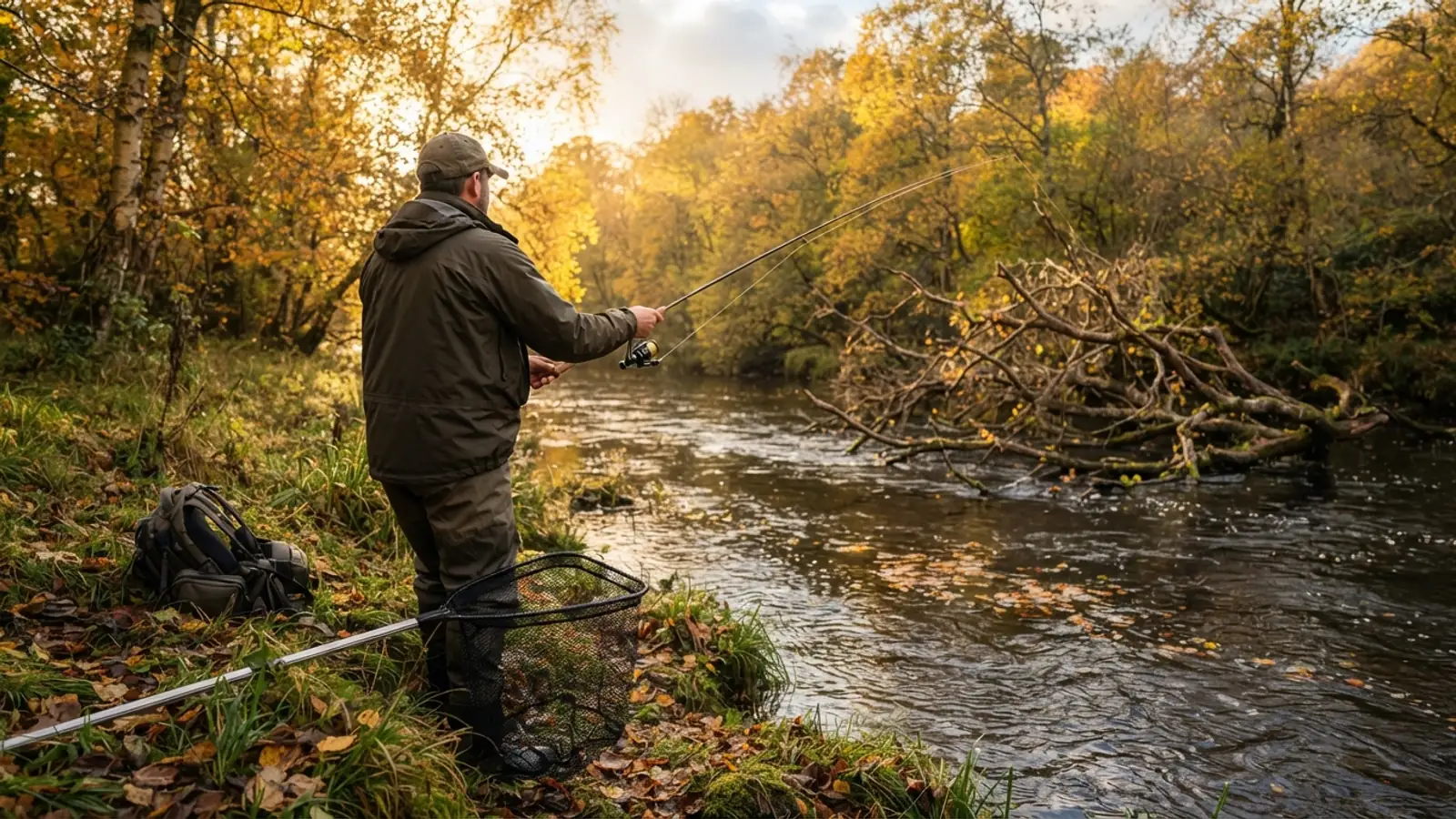
Autumn has a reputation as the best time for pike. Many anglers wait for a feeding frenzy that is supposed to start on a certain date. The studies point to the water instead. As it cools, pike spread their activity over more of the day, and in one German lake catches went up. That cooling comes weeks apart on different lakes. Here is when the autumn bite starts, which hours work, where pike hold and what to check before you go.
Do pike really go on an autumn feeding frenzy?
Feeding studies don't show a clear autumn spike. Wild pike in a Canadian lake ate the most from May to August, with a peak in June. In summer a meal took them about two days to digest, in winter about twelve (Diana, 1979). In a trial that copied natural conditions, pike needed the most food in late June and much less from October on (Johnson, 1966). One study in Turkey did find the fullest stomachs in autumn. Small pike there also had fuller stomachs than big ones (Yazıcıoğlu and colleagues, 2018).
Catches are a different story. Researchers in Germany fished a small lake from spring to autumn and logged every pike (Kuparinen and colleagues, 2010). Catch rates went up as the water cooled, on windy days and at dusk. They dropped after heavy fishing on the two days before, and air pressure showed no link at all. So there is something to the autumn bite, at least in that lake. It came with the cooling water, and the calendar only gave a rough hint of when.
When does the autumn bite start?
Watch for the water in your lake to drop below about 19 °C (66 °F). Given a choice in the lab, adult pike pick water of about 19 to 20 °C (66 to 68 °F) (Casselman, 1978). In three Minnesota lakes, big pike chose 16 to 21 °C (61 to 70 °F) even when warmer water was on offer. In summer, warm water above and low oxygen below can leave them little room (Pierce and colleagues, 2013). As the lake cools, that squeeze eases.
When that happens depends on your lake. The chart shows ten Polish lakes, measured every day in autumn 2024 by the national weather and water service.
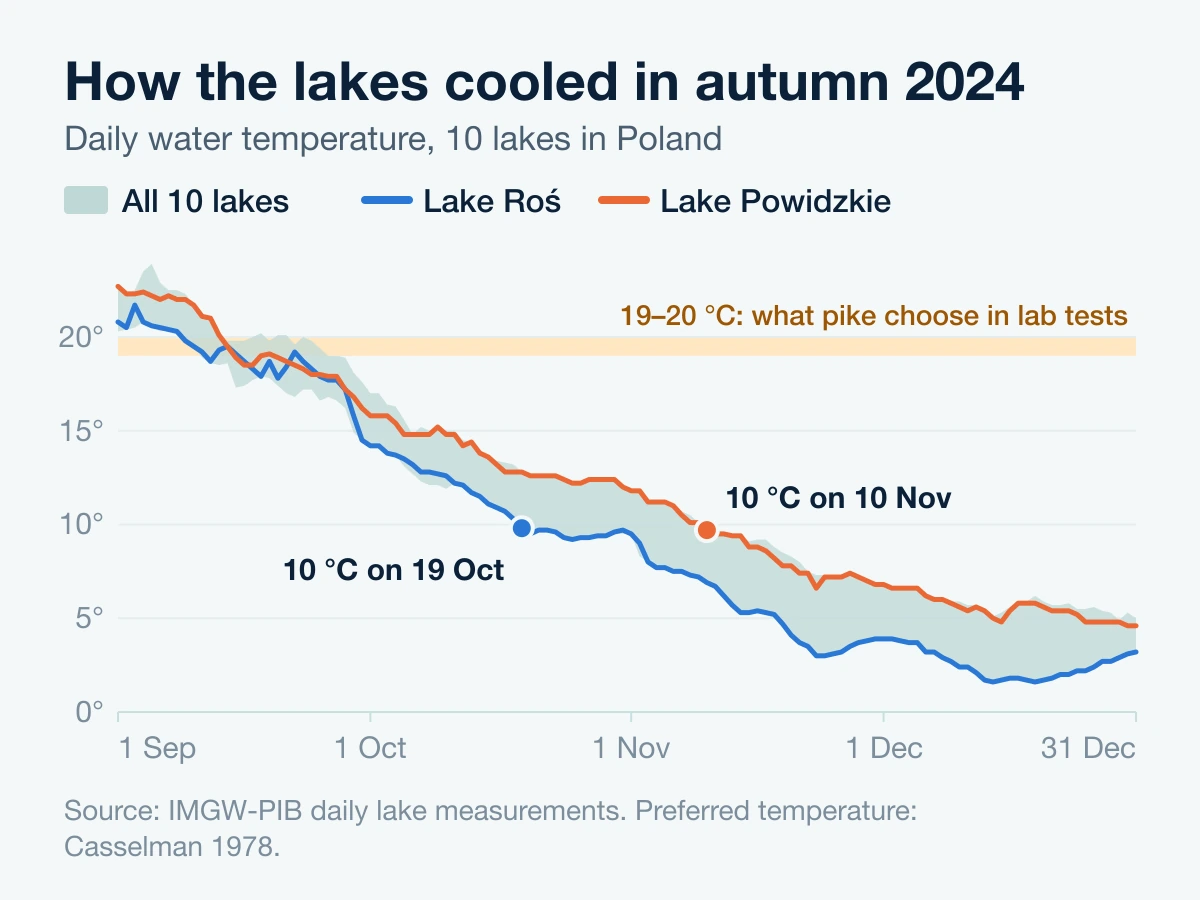
All ten lakes dropped below 19 °C between 11 and 28 September. On 1 November they were at 9.5 to 11.8 °C (49 to 53 °F), on 1 December at 4 to 7 °C (39 to 45 °F). Take 10 °C as a marker: the first lake got there on 19 October and the last on 10 November, three weeks later. Even Lake Mikołajskie, in the same lake district as Lake Roś, got there 18 days after it.
What time of day do pike bite in autumn?
Pike hunt by sight, and they are day fish. In a Danish lake, tagged pike were followed from late summer into winter. In every period they were more active by day than at night (Baktoft and colleagues, 2012). In a Canadian lake, pike barely moved at night (Diana, 1980).
The shape of the day shifts with the season. In July, pike in the same German lake moved most around dawn and dusk. In January and February those peaks were gone (Kobler and colleagues, 2008). A Colorado reservoir showed the same switch, with twilight peaks in summer and a plain daytime pattern in winter (Cook and Bergersen, 1988). In early autumn, dawn and dusk still pay. By November the whole day counts, and midday is just as good. Night trips for pike rarely make sense.
Where do pike hold in autumn?
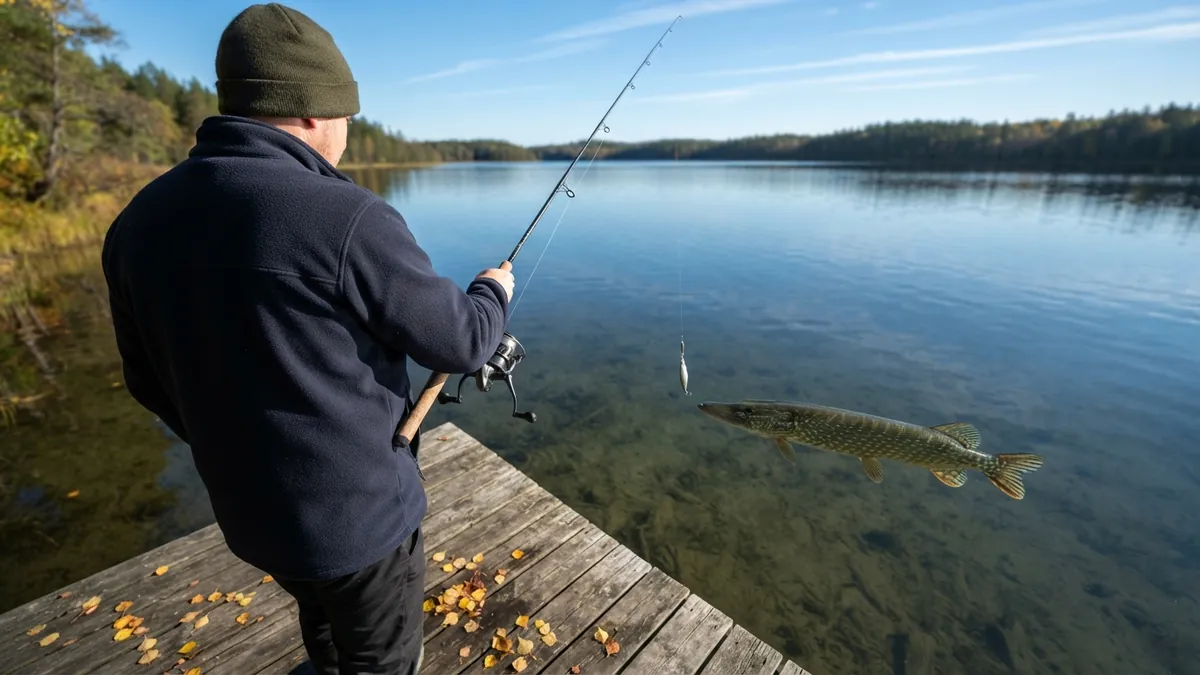
There is no single rule, and 'pike go deep in autumn' isn't one. In a Czech reservoir, tagged pike stayed at about 3 m in autumn, the same depth as in summer. Their activity went up at the same time (Říha and colleagues, 2022). In the Minnesota lakes, low oxygen in deep water usually decided how deep pike could go. While the lake turned over, they used a wider range of depths (Pierce and colleagues, 2013). In a Colorado reservoir, pike moved least in October, and weed cover was their key habitat (Cook and Bergersen, 1988). On windy days pike moved farther from the shore, but not necessarily deeper, and on sunny days they came closer in (Chapman and Mackay, 1984).
- The last green weed beds and their outer edges. Pike stay near cover as long as it lasts.
- Drop-offs next to shallow bays where small fish gather.
- On a windy day, water farther out from the bank.
- On a bright, calm day, the shallows close to shore.
- In rivers, the places where the current slows: bends, backwaters and harbour mouths.
Which weather is best for autumn pike?
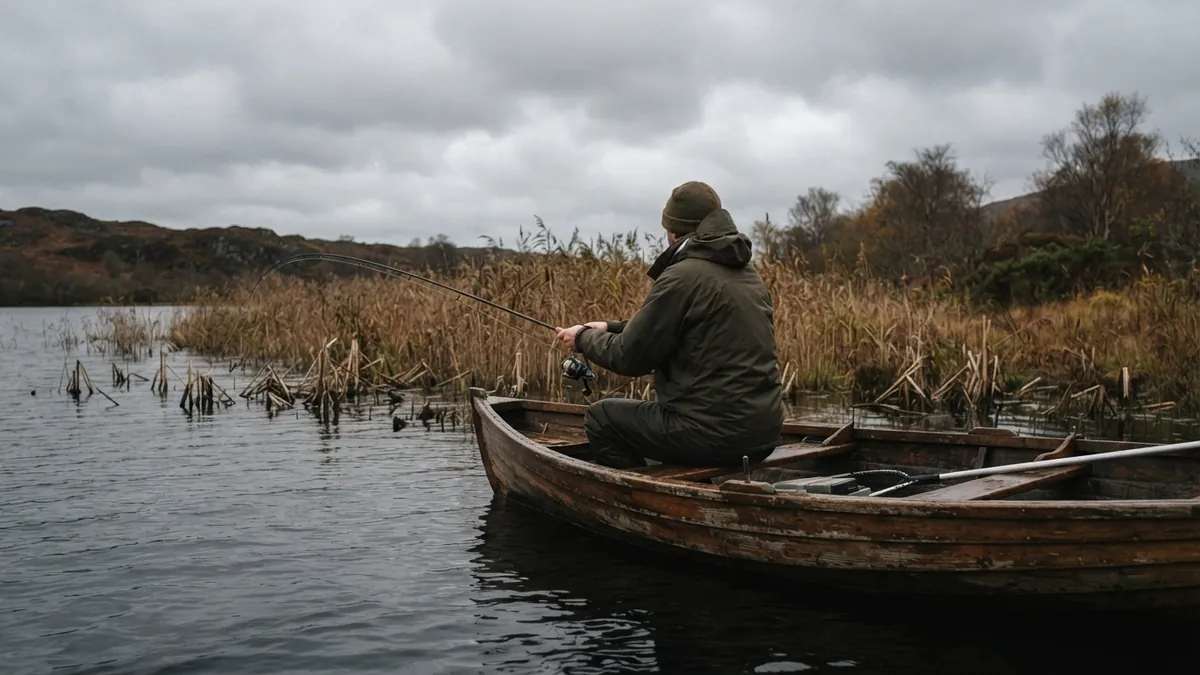
Wind helps. In the German study, catch rates rose with wind speed (Kuparinen and colleagues, 2010). One possible reason is that ripples break up the light, which helps a fish that attacks from cover. Rain made no difference to where pike stayed in a Canadian lake (Chapman and Mackay, 1984).
Pressure and the moon explain little. Air pressure had no link to catches in the German lake. The same study found more pike around full and new moon, but that was one lake in one summer, and the result hasn't been repeated. So klewa counts the moon only a little, and only for pike. From dawn to dusk it moves the index by 3% at most: up around full and new moon, down at the quarter moons.
What changes for pike in November?
Cold water slows everything down. In winter, pike in the Canadian lake needed about twelve days to digest a meal (Diana, 1979). That means fewer meals. Pike don't stop eating, though. In a tank trial, young pike fed almost as well at 5 °C as at 13 °C (41 and 55 °F) (Nilsson-Örtman and colleagues, 2026). Days are short now, so plan around the brightest hours. And give a busy spot a rest. In a whole-lake experiment, pike learned to avoid lures within about a week (Arlinghaus and colleagues, 2017).
How do you plan an autumn pike trip?
- Check the water temperature for your spot, not the date.
- While the water is still warm, fish dawn and dusk. Once it is cold, midday is just as good.
- Choose windy days over calm ones when you can.
- Start at the last green weeds and the drop-offs beside them.
- Skip the night. Pike hunt by day.
- Rest a spot after a busy weekend.
Is there a closed season for pike?
In most places autumn is open season, and the closures come in spring around spawning. In England the coarse fish close season runs from 15 March to 15 June on rivers, streams and drains, while most stillwaters and many canals stay open. The national byelaws let you keep one pike a day, up to 65 cm. In the US, seasons and limits are set by each state. Check your local rules and your club's or fishery's own terms, which can be stricter.
klewa handles the water part. Pick your spot and pike, and the forecast estimates the water temperature and rates the next 24 hours. You'll see which hours look best before you leave home.
See today's best hours for pike at your spot.
Open the forecast