Best Time of Day to Fish: Dawn, Dusk, Day or Night?
Ask five anglers when fish bite best and most will say dawn and dusk. For many predators in warm water that is a fair bet. It isn't a rule for every fish, though. Pike and perch are day hunters, and carp and catfish lean towards the night in summer. Cold water evens out the day for pike, while perch get sharper peaks. So the best time depends on the species and the water temperature. Here is what the studies show for each.
Do fish really bite best at dawn and dusk?
Often, yes, but the evidence is thinner than the rule suggests. A major review of daily rhythms in fish found that most species have an internal clock, yet many switch between being active by day and by night. Light, temperature, danger and food help decide which (Reebs, 2002). Most studies track movement or stomach contents. Only a handful count catches by time of day. One of the largest covers 13 years of walleye fishing on a lake in Wisconsin (Shaw and colleagues, 2021).
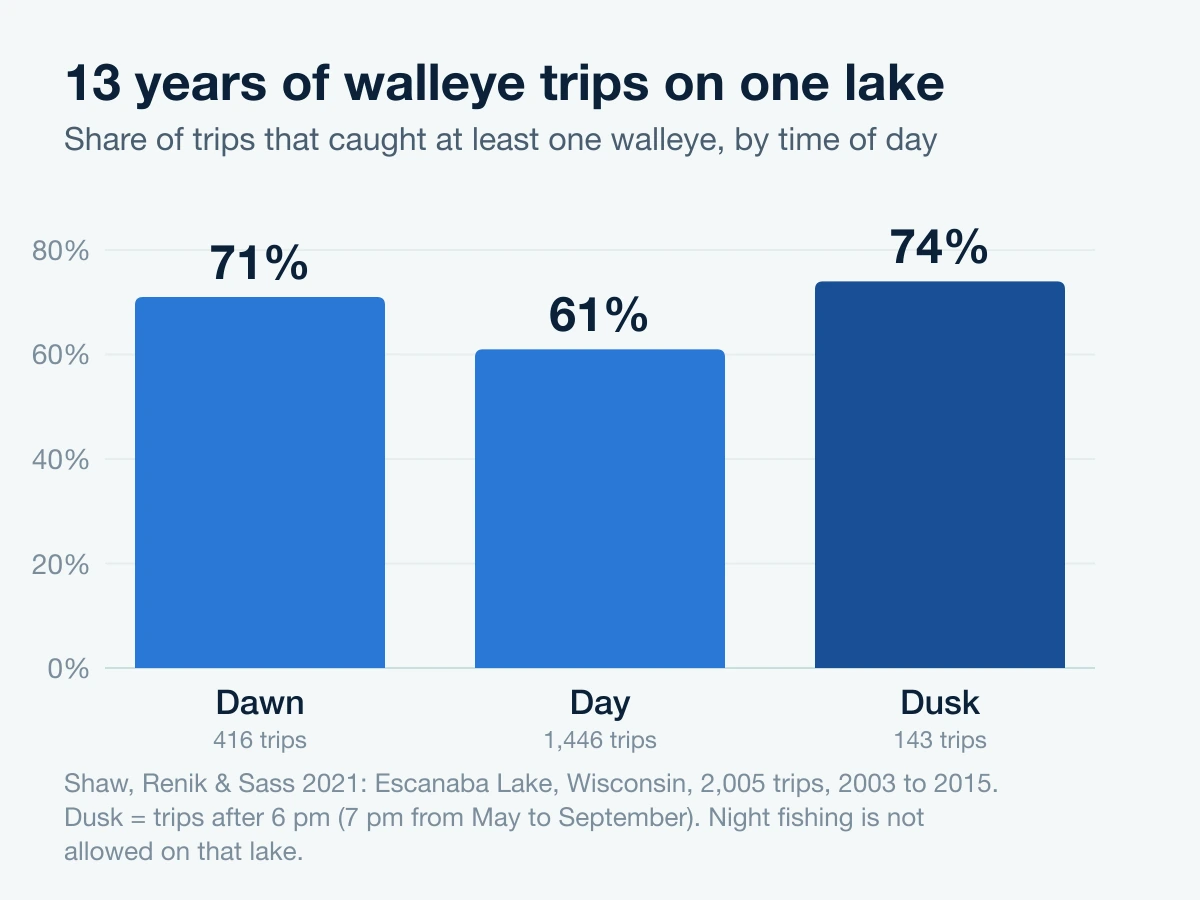
Evening trips there were the most successful. About 74 percent of evening trips caught at least one walleye, against 71 percent in the morning and 61 percent during the day. The researchers' model, which also weighs guides, bait and the weather, puts them in the same order. That fits walleye, a low-light hunter. Two caveats: it is one lake and one species, and night fishing isn't allowed there, so evening means the hours before dark. A guide or live bait made a bigger difference than the time of day.
When do pike and perch bite?
Pike hunt by day. In a Danish lake, tagged pike were followed from late summer into winter, and in every period they were more active by day than at night (Baktoft and colleagues, 2012). In a small German lake, pike had activity peaks at dawn and dusk in summer, and in winter those peaks were gone (Kobler and colleagues, 2008). Anglers on the same lake caught more pike at dusk (Kuparinen and colleagues, 2010). Night is the weak time. In a Canadian lake, pike barely moved after dark (Diana, 1980).
Perch are day fish too. In a Danish lake, large perch were active by day all year. From October to April they had clear peaks at dawn and dusk or around midday. In summer the day was flatter, and as the water warmed they moved a little at night as well (Jacobsen and colleagues, 2002).
When do zander and walleye bite?
Zander and walleye are low-light specialists. In the Czech part of the River Elbe, tagged zander stayed deep by day, moved into shallower water at twilight and sat in the shallows at night. They moved most at twilight and least at night (Horký and colleagues, 2008). In a turbid Danish reservoir they were most active from 6 pm to midnight (Jepsen and colleagues, 1999). Walleye net catches peaked shortly after dusk (Kelso, 1978). So plan on dusk and the first hours of darkness. What happens in the middle of the night is less certain.
When do carp, catfish and bream bite?
Carp and catfish lean towards the night in summer. Carp in a Minnesota lake fed largely at night (Bajer and colleagues, 2010). At baited spots they showed up from dusk into the morning and rarely in full daylight (Hundt and colleagues, 2022). A tracking study in a Spanish reservoir adds a caveat. Carp there moved less at night in the warm season, and from December to April they had almost no daily rhythm (Benito and colleagues, 2015). Wels catfish in a Swedish lake were mainly active at night in summer and late autumn, rising towards the surface at dusk (Bergström and colleagues, 2024). In a Czech river they were active around the clock in summer. In autumn they were most active at dusk, and in winter they were quiet, with small daytime peaks (Slavík and colleagues, 2007).
Bream and roach feed mainly by day in summer (Vašek and Kubečka, 2004), and nets catch the most around sunset and sunrise (Prchalová and colleagues, 2010). As the water cools from 20 to 10 °C (68 to 50 °F), roach move their feeding from the day to twilight (Hautala, 2008).
What about bass, crappie, bluegill and trout?
Largemouth bass are active by day (Demers and colleagues, 1996). In a southern reservoir they rested offshore by day and used the shoreline mostly in low light (Sammons and Maceina, 2005). We found no study that counts bass bites by the hour, though. In trap nets in a small Ohio lake, black crappie, bluegill and bass were caught least from 10 pm to 4 am. Larger black crappie peaked at dusk (Shoup and colleagues, 2004). Bluegill feed mostly by day (Keast and Welsh, 1968). Brown trout in a Belgian stream were most active at dusk in every season (Ovidio and colleagues, 2002).
How does water temperature change the best time?
Water temperature changes the daily pattern, and each fish reacts in its own way. Warm water pushes some, like carp and wels catfish, towards the night. Cold water evens out the day for some. Pike lose their dawn and dusk peaks in winter (Kobler and colleagues, 2008). Carp have almost no daily rhythm from December to April (Benito and colleagues, 2015). Perch go the other way and show their clearest peaks in the cold months (Jacobsen and colleagues, 2002). The chart sums up what the studies found for six common species.
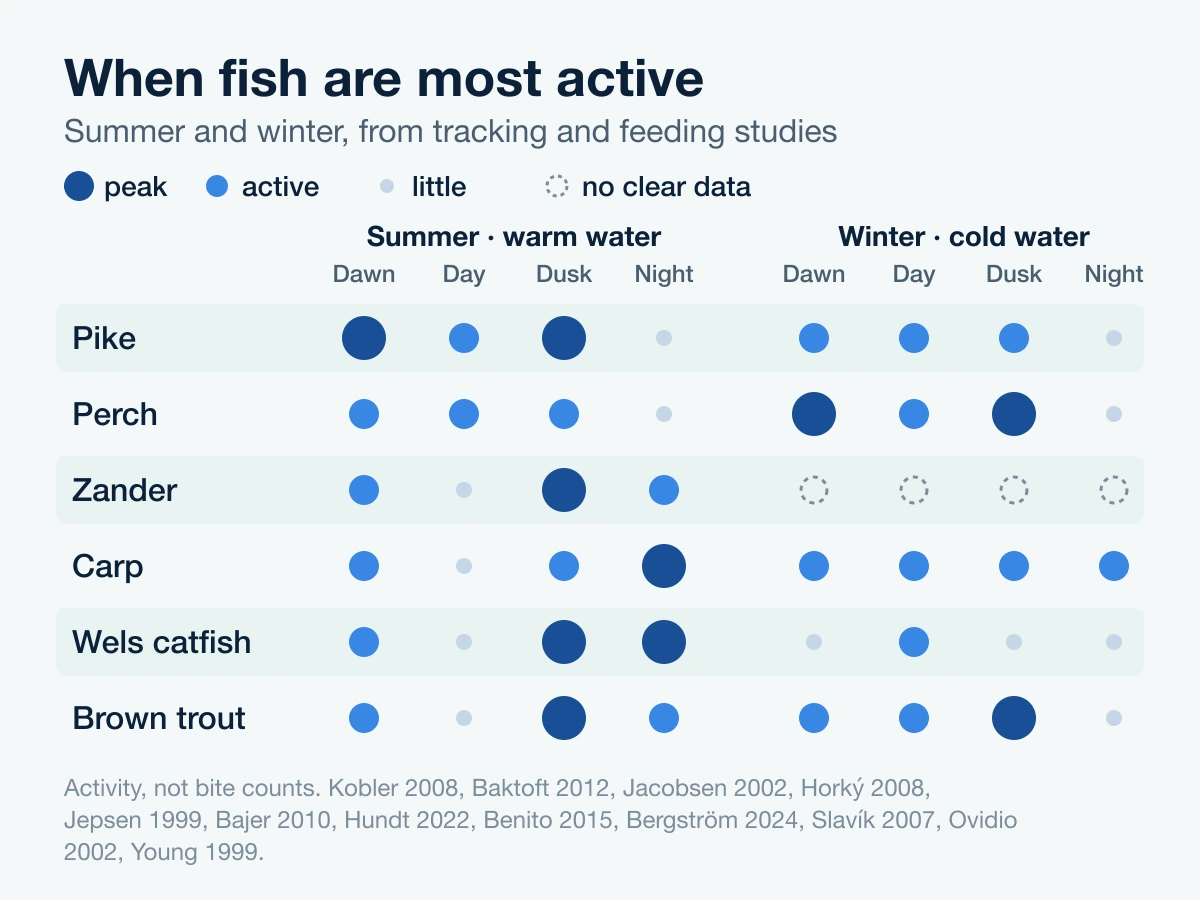
Read it as a guide to when fish move and feed, not as a count of bites. All of these studies followed tagged fish. Where studies disagree, as with carp at night, the chart follows the feeding studies. For wels in summer it follows the Swedish lake, and for zander in winter we found no clear data.
- Pike: a day fish. Dawn and dusk in summer, the whole day in cold water.
- Perch: a day fish. Clearest peaks from October to April, at dawn, dusk or midday.
- Zander and walleye: dusk and the first hours of darkness.
- Carp: from dusk into the morning in summer, no clear pattern in winter.
- Wels catfish: night and dusk in summer, quiet in winter.
- Brown trout: dusk, in every season.
- Largemouth bass: active by day, on the shoreline mostly in low light.
Is midday fishing a waste of time?
Not for many fish. Pike, perch and bass are active by day, and in cold water midday is worth fishing for pike and perch too. Midday is the weak spot mainly for zander and walleye in clear water, and for carp and catfish in summer.
Do solunar tables tell you when to go?
Not reliably. In a study of trout fishing in North America, popular solunar tables did not predict catch rates, and air temperature did better (Quigley and colleagues, 2023). In the Wisconsin walleye data the moon's effects were very small (Shaw and colleagues, 2021). So klewa works from the real sunrise and sunset at your spot, not from moon tables. The moon phase counts only for pike, and only a little: 3% at most.
How do you find the best hours at your water today?
Check three things: the species, the water temperature and the light. klewa does that for you. Pick a spot and a fish, and the forecast rates the next 24 hours from sunrise and sunset at your spot, the estimated water temperature and the weather. The time-of-day curve changes with the species and with how warm the water is.
See the best hours for your fish at your spot today.
Open the forecast