Fall Turnover: Why the Lake Goes Quiet and When the Bite Comes Back
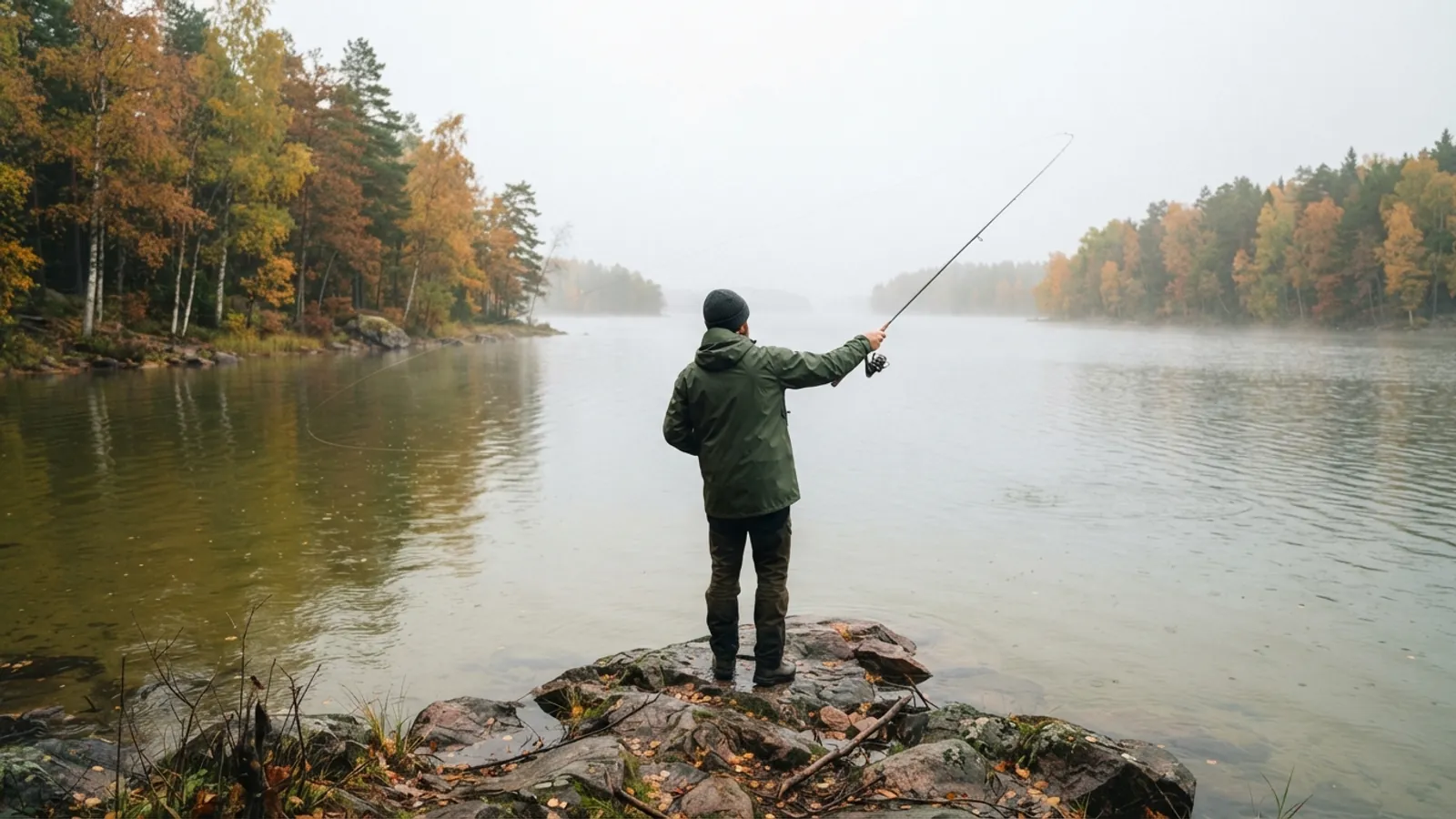
Every autumn plenty of anglers hit the same wall. A spot that fished well all September goes dead for a week or two, sometimes longer. Often the reason sits under the surface: the lake is turning over. In summer a deep lake splits into a warm top layer and a cold, stale bottom layer. Once autumn has cooled the surface enough, wind mixes the whole lake together. For a while the fish lose the water they were using, and the lake turns murky. When it settles, oxygen is back at every depth, and pike, zander and perch often feed hard again.
What your lake looks like underneath in late summer
By late summer, a lake deeper than a few metres isn't one body of water. It's three. On top sits warm water that the wind keeps stirring. Below it is a thin band where the temperature drops fast, which scientists call the thermocline. Under that lies cold, still water that hasn't touched the air since spring.
That deep layer has a problem. Bacteria in the mud use up its oxygen all summer, and nothing tops it up. By August the bottom of many lakes is short of oxygen, so the fish live in the top layer.
The top layer isn't generous either. Warm water holds less oxygen: about 9.1 mg per litre at 20 °C (68 °F) and only 7.5 at 30 °C (86 °F). Each species needs a different amount. In feeding studies trout and pike start eating less below about 7 mg per litre, largemouth bass below about 6, carp below about 4.5 and perch below about 4. Crucian carp manage with less still. The warmer the water, the more they all need.
How autumn breaks the layers
Cold nights and cold rain chill the surface. Cooler water is heavier, so it sinks, and the warm top layer grows thicker week by week. Then an autumn storm rolls through and finishes the job. The wind pushes the water around until top and bottom are one again.
Plenty of fishing articles say a lake flips at 4 °C (39 °F). It doesn't wait that long. The layers break as soon as the surface has cooled to the temperature of the deep water. In a deep, cold lake that is close to 4 °C. In a shallower one it can be several degrees warmer. After that the mixed lake keeps cooling as a whole until it reaches 4 °C, where fresh water is at its heaviest.
Every water keeps its own timetable. Shallow bays and small ponds flip first, and big deep basins go last. A reservoir that draws water off the bottom, or a very shallow lake that mixes all summer anyway, may show no clear turnover at all.
Why the bite goes quiet
We have to be straight with you here. The physics of turnover is well studied. The quiet week is much less so: we found no controlled study that measured fish eating less during turnover. What we do have is years of anglers' reports, plus three physical reasons that explain them.
- Stale deep water gets spread through the lake. In a big lake it thins out quickly, though pockets can still run low on oxygen. In a deep pond it can even kill fish.
- Fish lose the layer they were holding in. Baitfish scatter, the predators follow, and a spot that held fish yesterday is empty today.
- The water goes murky. Nutrients and fine material from the bottom cloud it up, so a pike or zander hunting by sight can't see as far.
Trout and pike feel an oxygen dip first. Perch, carp and crucian carp cope with far less.
How long it lasts
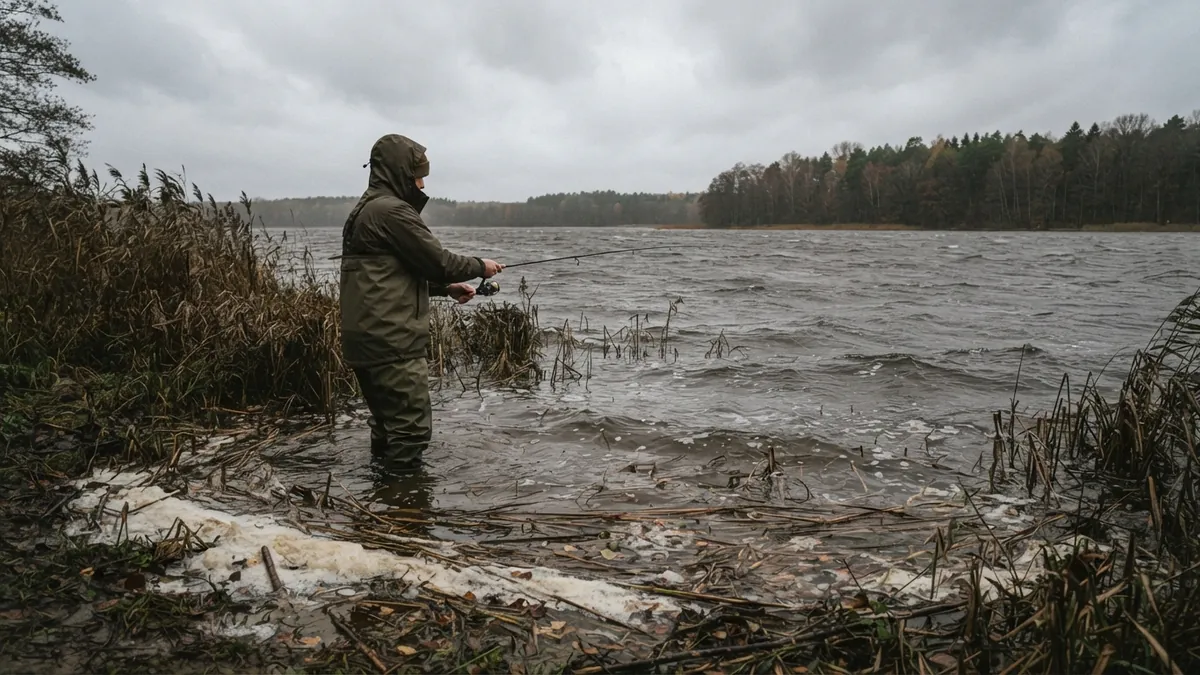
Anglers often mix up two different things. The first is the breakdown itself, when the layers collapse and the water churns. It is usually short. A small pond can be done in hours or a couple of days. A typical lake takes about a week. A large, deep reservoir can drag it out for weeks.
The second is the mixed lake that follows. That stage lasts much longer, often until the ice comes, and it isn't the quiet spell. Depth, size, shelter from the wind and how fast the weather cools all shift these timings, so treat them as rough guides.
klewa follows the water trend for you. For every hour it compares its modelled water temperature with the same hour three days earlier, and a drop of 1.5 °C (2.7 °F) or more counts as falling. You won't see the water temperature in the forecast, only its effect: cooling that brings pike back toward its band lifts the index a little.
Who gains and who loses as the water cools
The same cooling that flips the lake moves every species through its own comfort zone. Some get their appetite back as it happens, and some lose it.
- Pike do best at 7 to 19 °C (45 to 66 °F). At 23 °C (73 °F) our model rates their ability to feed at 0.5 out of 1, and near 28 °C (82 °F) almost nothing is left. As the lake cools from its summer peak, pike move back into their band.
- Zander do best at 12 to 24 °C (54 to 75 °F), so autumn keeps them in their band for weeks. Walleye anglers can use this as a rough guide, because zander are the walleye's closest European relative, but the model has no walleye numbers of its own.
- Perch like 12 to 23 °C (54 to 73 °F).
- Largemouth bass want 17.5 to 29 °C (64 to 84 °F). At 14 °C (57 °F) the model puts them at about 0.7.
- Carp and catfish are warm-water fish, and every cold week costs them.
The direction of the change matters a little. For every hour klewa compares the water with the same hour three days earlier. A change that brings a fish back toward its band, like cooling for pike after a hot summer, adds 5 percent. A change that pushes it further out, like cooling for carp and catfish once the water is below their band, takes 5 percent off. Inside the band the trend changes nothing. For how temperature and timing work together on any given day, see our article on why the fish aren't biting.
When the bite comes back
Once the lake has mixed and calmed down, the temperature is about the same from top to bottom, and oxygen is back at every depth. That opens up the deep water again. Fish often spread out for a while before they gather on their winter spots.
Cool water also holds far more oxygen: about 11.3 mg per litre at 10 °C (50 °F), against 9.1 at 20 °C (68 °F). For cold-water predators, oxygen stops being a limit at all. Many anglers call this stretch the autumn feeding spree. No study we found measured an autumn feeding peak, though. In walleye, intake fell as the water cooled, and in one study pike ate most in June. What autumn does is bring pike back into its band after the summer heat. Zander and perch mostly stay in theirs all summer, unless the water climbed past 23–24 °C (73–75 °F).
When the water stops falling, the score simply follows the temperature, though your own lake can still surprise you.
What the forecast can see, and what only you can see
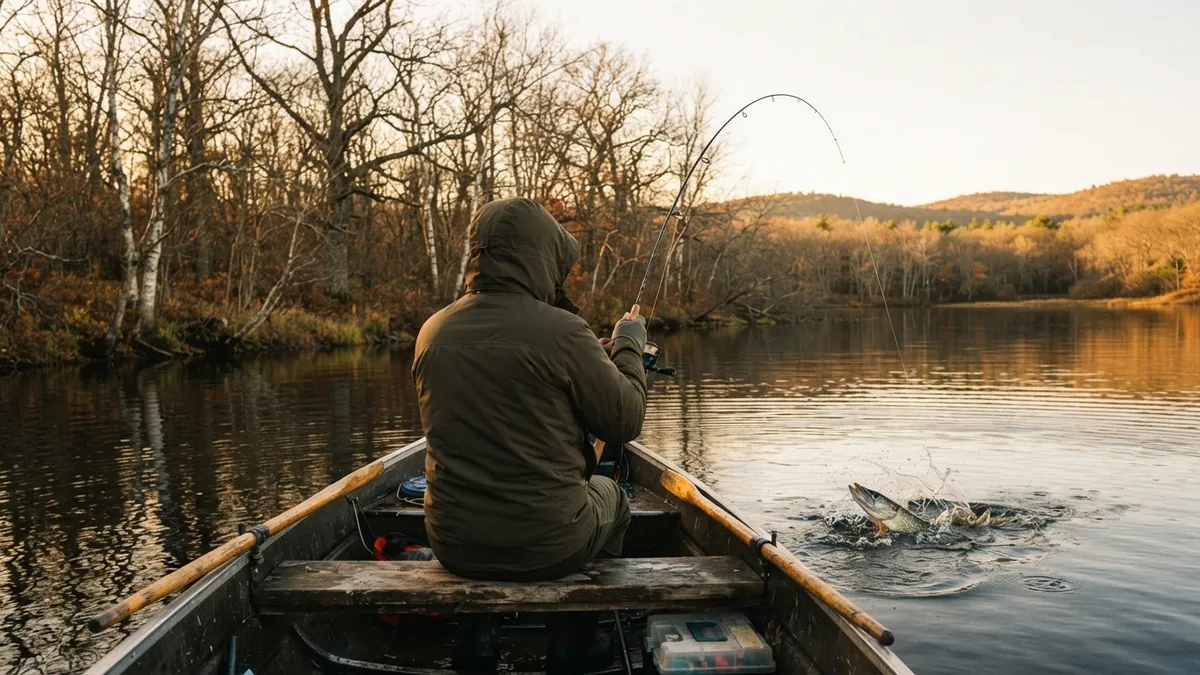
klewa doesn't measure your lake. It estimates water temperature with a physics model fed by the weather: air temperature, sunshine, wind and rain. The oxygen score is worked out from that temperature, the altitude and the wind. It is calculated, not sampled, so it can't see oxygen running out near the bottom.
So the forecast can tell you the weather is cooling your water quickly, and that's what drives turnover. What it can't see is stale deep water rising in one particular basin. Put the two sources together:
- From the forecast: a cold front passing through, a spell of strong wind, the index for pike climbing back up.
- On the water: brown or grey murk in a lake that was clear last week, a rotten-egg or musty smell, lines of foam and debris, dead weed floating up.
- On the sonar: fish marks spread through the whole water column instead of holding at one depth.
When the forecast and the water agree, you can be fairly sure the lake is mixing.
A plan for turnover weeks
Driving back to the summer spot and hoping rarely pays off. Try this instead.
- Fish water that turns over at a different time. A shallow bay or a small pond may have flipped already, while a big deep basin may not have started yet.
- Look for clear water. A river has no layers to break, so it often fishes normally while the lakes are churning.
- Use the best hours. Time of day carries the most weight in the forecast, 0.36, so let the daily chart pick your hours rather than fishing through the slow ones.
- Go back to your lake once the weather has settled and the water has cleared.
One last thing before you head out: check your local rules. In parts of Europe, closed seasons for some predators start in autumn.
Open the forecast for your lake and follow the bite index through October.
Check your lake's forecast